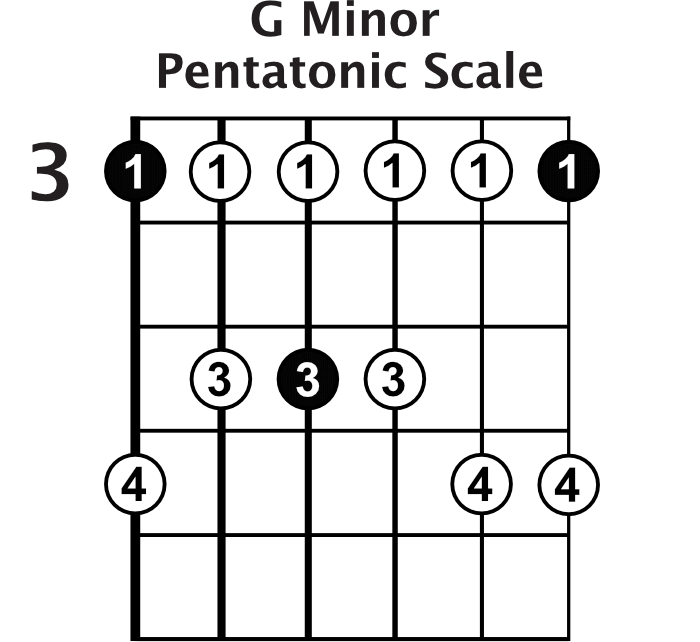
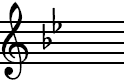
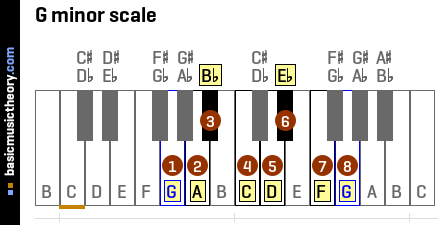
G minor is a minor scale based on G, consisting of the pitches G, A, B♭, C, D, E♭, and F. Its key signature has two flats. Its relative major is B-flat major and its parallel major is G major.
The G natural minor scale is:
Changes needed for the melodic and harmonic versions of the scale are written in with accidentals as necessary. The G harmonic minor and melodic minor scales are:
Scale degree chords
The scale degree chords of G minor are:
- Tonic – G minor
- Supertonic – A diminished
- Mediant – B-flat major
- Subdominant – C minor
- Dominant – D minor
- Submediant – E-flat major
- Subtonic – F major
Mozart's use of G minor
G minor has been considered the key through which Wolfgang Amadeus Mozart best expressed sadness and tragedy, and many of his minor key works are in G minor, such as Piano Quartet No. 1 and String Quintet No. 4. Though Mozart touched on various minor keys in his symphonies, G minor is the only minor key he used as a main key for his numbered symphonies (No. 25, and the famous No. 40). In the Classical period, symphonies in G minor almost always used four horns, two in G and two in B♭ alto. Another convention of G minor symphonies observed in Mozart's No. 25 and Mozart's No. 40 was the choice of E-flat major, the subdominant of the relative major B♭, for the slow movement, with other examples including Joseph Haydn's No. 39 and Johann Baptist Wanhal's G minor symphony from before 1771.
Notable works in G minor
See also
- Key (music)
- Major and minor
References
External links
- Media related to G minor at Wikimedia Commons