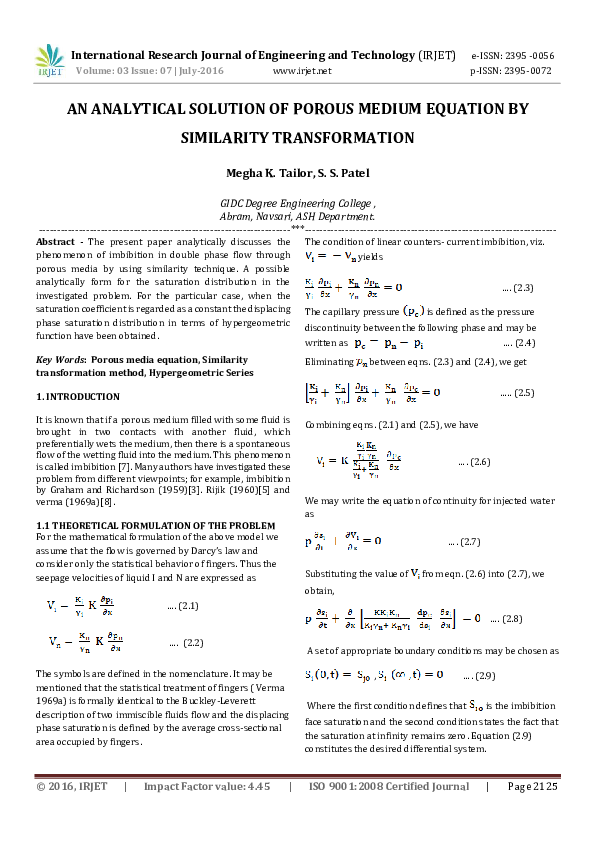
The porous medium equation, also called the nonlinear heat equation, is a nonlinear partial differential equation taking the form:
where is the Laplace operator. It may also be put into its equivalent divergence form:where may be interpreted as a diffusion coefficient and is the divergence operator.
Solutions
Despite being a nonlinear equation, the porous medium equation may be solved exactly using separation of variables or a similarity solution. However, the separation of variables solution is known to blow up to infinity at a finite time.
Barenblatt-Kompaneets-Zeldovich similarity solution
The similarity approach to solving the porous medium equation was taken by Barenblatt and Kompaneets/Zeldovich, which for was to find a solution satisfying:for some unknown function and unknown constants . The final solution to the porous medium equation under these scalings is:where is the -norm, is the positive part, and the coefficients are given by:
Applications
The porous medium equation has been found to have a number of applications in gas flow, heat transfer, and groundwater flow.
Gas flow
The porous medium equation name originates from its use in describing the flow of an ideal gas in a homogeneous porous medium. We require three equations to completely specify the medium's density , flow velocity field , and pressure : the continuity equation for conservation of mass; Darcy's law for flow in a porous medium; and the ideal gas equation of state. These equations are summarized below:where is the porosity, is the permeability of the medium, is the dynamic viscosity, and is the polytropic exponent (equal to the heat capacity ratio for isentropic processes). Assuming constant porosity, permeability, and dynamic viscosity, the partial differential equation for the density is:where and .
Heat transfer
Using Fourier's law of heat conduction, the general equation for temperature change in a medium through conduction is:where is the medium's density, is the heat capacity at constant pressure, and is the thermal conductivity. If the thermal conductivity depends on temperature according to the power law:Then the heat transfer equation may be written as the porous medium equation:with and . The thermal conductivity of high-temperature plasmas seems to follow a power law.
See also
- Diffusion equation
- Porous medium
References
External links
- The Porous Medium Equation: Mathematical theory